
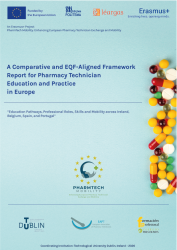
A Comparative and EQF-Aligned Framework Report for Pharmacy Technician Education and Practice in Europe
Keywords:
Pharmacy Technicians, Comparative Educational Curricula, Comparative Roles, Comparative Responsabilities, Professional and Transferable Skill, PharmTech Mobility ProjectSynopsis
Preface
The PharmTech Mobility: Enhancing European Pharmacy Technician Exchange and Mobility project, hereafter referred to as PharmTech Mobility, was established under the Erasmus+ programme, KA210-VET – Small-scale Partnerships in Vocational Education and Training (KA210-VET). The project reference is 2024-1-IE01-KA210-VET-000245362.
This initiative brings together partners from Ireland, Belgium, Spain, and Portugal to address a longstanding challenge: the lack of a harmonised educational and professional framework for pharmacy technicians across the European Union (EU). Pharmacy technicians are vital members of the healthcare workforce. They ensure the safe preparation, dispensing, and management of medicines, supporting pharmacists and wider healthcare teams in both community and hospital settings.
Across Europe, however, the education, regulation, and scope of practice of pharmacy technicians vary considerably. In some countries, such as Portugal, Spain, and Belgium, pharmacy technicians are regulated professionals with clearly defined responsibilities and recognised qualifications. In others, such as Ireland [1], the role is less formally regulated, with education and practice standards differing in duration, scope, and depth.
This diversity creates challenges for workforce mobility and mutual recognition of qualifications. It also limits opportunities for pharmacy technicians to fully contribute to European healthcare systems, at a time when the demand for highly skilled healthcare professionals continues to grow due to demographic changes, evolving health service needs, and increasingly complex pharmaceutical care.
The motivation for PharmTech Mobility stems from this lack of coherence. Educational pathways for pharmacy technicians range from vocational training at secondary level to higher education awards, and their roles differ significantly. In some contexts, technicians may engage in aseptic compounding, ward-based medicines optimisation, and advanced patient-facing services. In others, their responsibilities may focus primarily on dispensing and inventory management. Against this backdrop, the PharmTech Mobility project was developed to:
- Map and compare existing pharmacy technician education and training structures in the four participating countries, identifying areas of convergence and divergence.
- Develop a shared educational framework structured by the European Qualifications Framework (EQF), defining knowledge, skills, and competences across different levels.
- Define roles and responsibilities of pharmacy technicians in both community and hospital contexts, including emerging and advanced practice roles.
- Identify professional and transferable skills such as communication, digital literacy, teamwork, and adaptability that support employability and career progression.
- Facilitate mobility and recognition by promoting transparency in qualifications and supporting mutual recognition of competences across the EU.
This report represents a key output of the project and is structured into three main chapters:
- Chapter 1 presents a comparative curriculum framework, organised by EQF levels, covering scientific foundations, pharmacy practice, professional development, and applied skills. It also incorporates Work Placement as a core component, highlighting its essential role in providing supervised, hands-on experience in real-world healthcare settings.
- Chapter 2 describes the roles and responsibilities of pharmacy technicians, showing how expectations evolve from entry-level tasks to more advanced professional functions.
- Chapter 3 defines the professional and transferable skills that enable pharmacy technicians to succeed in diverse and dynamic healthcare environments.
The framework proposed in this report does not aim to impose uniformity. National systems and regulations will continue to reflect local healthcare models, traditions, and labour market needs. Instead, this framework serves as a shared reference point to encourage alignment, dialogue, and progressive harmonisation across borders. [..]
Downloads
Published
2026
Series
Categories
Copyright (c) 2026 Tao Zhang, Seána Hogan, Christine O’Connor, Cristiano Matos, João José Joaquim, Ângelo Jesus, Carolina Valeiro, Isabel Elguero Claramunt, María Jesús Aparicio Cabezas, Antonio Rodrigo Díaz, Alejandra Reyes Moreno
License

This work is licensed under a Creative Commons Attribution-NonCommercial 4.0 International License.
Details about this monograph
ISBN-13 (15)
978-989-9226-09-8