
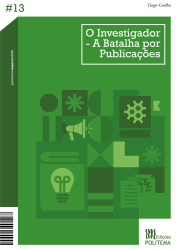
O Investigador - A Batalha por Publicações: livro de instruções
Keywords:
Research, scientific publishing, serious gameSynopsis
Publishing in peer-reviewed scientific journals is challenging. In addition to preparing an article that thoroughly describes the process and results of their research, authors must be able to select the most appropriate journal for submission, taking into account factors such as scope, indexing, impact, average response time, access policy to publications, possible processing fees and editorial guidelines. In addition, authors must be prepared to consider reviewers' comments and adjust the work as necessary, as well as deal with the possibility of rejection. This requires not only scientific proficiency, but also resilience and adaptability along the arduous path to publication.
With the primary objective of preparing higher education students and early-career researchers for the process of publishing articles in scientific journals and the challenges often associated with this experience, an innovative teaching resource was developed: a serious board game entitled “The Researcher - The Battle for Publications”. This publication not only explores the difficulties inherent in scientific publishing but also presents a detailed description of the game development process, its instructions and complementary teaching material.
References
Aarssen, L., Tregenza, T., Budden, A., Lortie, C., Koricheva, J., & Leimu-Brown, R. (2008). Bang for Your Buck: Rejection Rates and Impact Factors in Ecological Journals. The Open Ecology Journal, 1. https://doi.org/10.2174/1874213000801010014
Abuhamdeh, S., & Csikszentmihalyi, M. (2012). The importance of challenge for the enjoyment of intrinsically motivated, goal-directed activities. Pers Soc Psychol Bull, 38(3), 317-330. https://doi.org/10.1177/0146167211427147
Al Noman, A., Sarkar, O., Mita, T. M., Siddika, K., & Afrose, F. (2024). Simplifying the concept of level of evidence in lay language for all aspects of learners: In brief review. Intelligent Pharmacy, 2(2), 270-273. https://doi.org/https://doi.org/10.1016/j.ipha.2023.11.002
Ávila-Pesántez, D., Rivera, L. A., & Alban, M. S. (2017). Approaches for serious game design: A systematic literature review. Computers in education journal, 8(3).
Bartolomé, N. A., Zorrilla, A. M., & Zapirain, B. G. (2011, 27-30 July 2011). Can game-based therapies be trusted? Is game-based education effective? A systematic review of the Serious Games for health and education. 2011 16th International Conference on Computer Games (CGAMES),
Beugelsdijk, S., & Bird, A. (2024). How to avoid a desk reject: do’s and don’ts. Journal of International Business Studies. https://doi.org/10.1057/s41267-024-00712-8
Björk, B.-C. (2017). Growth of hybrid open access, 2009–2016. PeerJ, 5, e3878. https://doi.org/10.7717/peerj.3878
Björk, B.-C., Laakso, M., Welling, P., & Paetau, P. (2014). Anatomy of green open access. Journal of the Association for Information Science and Technology, 65(2), 237-250. https://doi.org/https://doi.org/10.1002/asi.22963
Björk, B.-C., & Solomon, D. (2013). The publishing delay in scholarly peer-reviewed journals. Journal of Informetrics, 7(4), 914-923. https://doi.org/https://doi.org/10.1016/j.joi.2013.09.001
Boone, A., Vander Elst, T., Vandenbroeck, S., & Godderis, L. (2022). Burnout Profiles Among Young Researchers: A Latent Profile Analysis [Original Research]. Front Psychol, 13. https://doi.org/10.3389/fpsyg.2022.839728
Bornmann, L., & Marx, W. (2016). The journal Impact Factor and alternative metrics: A variety of bibliometric measures has been developed to supplant the Impact Factor to better assess the impact of individual research papers. EMBO Rep, 17(8), 1094-1097. https://doi.org/10.15252/embr.201642823
Bornmann, L., Marx, W., Gasparyan, A. Y., & Kitas, G. D. (2012). Diversity, value and limitations of the journal impact factor and alternative metrics. Rheumatology International, 32(7), 1861-1867. https://doi.org/10.1007/s00296-011-2276-1
Brembs, B., Button, K., & Munafò, M. (2013). Deep impact: unintended consequences of journal rank [Review]. Front Hum Neurosci, 7. https://doi.org/10.3389/fnhum.2013.00291
Burns, P. B., Rohrich, R. J., & Chung, K. C. (2011). The Levels of Evidence and Their Role in Evidence-Based Medicine. Plastic and Reconstructive Surgery, 128(1), 305-310. https://doi.org/10.1097/PRS.0b013e318219c171
Carpenter, C. R., Cone, D. C., & Sarli, C. C. (2014). Using Publication Metrics to Highlight Academic Productivity and Research Impact. Academic Emergency Medicine, 21(10), 1160-1172. https://doi.org/https://doi.org/10.1111/acem.12482
Chapman, C. A., Bicca-Marques, J. C., Calvignac-Spencer, S., Fan, P., Fashing, P. J., Gogarten, J., Guo, S., Hemingway, C. A., Leendertz, F., Li, B., Matsuda, I., Hou, R., Serio-Silva, J. C., & Chr. Stenseth, N. (2019). Games academics play and their consequences: how authorship, h-index and journal impact factors are shaping the future of academia. Proceedings of the Royal Society B: Biological Sciences, 286(1916), 20192047. https://doi.org/doi:10.1098/rspb.2019.2047
Conn, V. S., Zerwic, J., Jefferson, U., Anderson, C. M., Killion, C. M., Smith, C. E., Cohen, M. Z., Fahrenwald, N. L., Herrick, L., Topp, R., Benefield, L. E., & Loya, J. (2016). Normalizing Rejection. West J Nurs Res, 38(2), 137-154. https://doi.org/10.1177/0193945915589538
Crijns, T. J., Ottenhoff, J. S. E., & Ring, D. (2021). The effect of peer review on the improvement of rejected manuscripts. Accountability in Research, 28(8), 517-527. https://doi.org/10.1080/08989621.2020.1869547
Csikszentmihalyi, M. (1990). Flow: The Psychology of Optimal Experience. Harper & Row.
Dantas-Torres, F. (2022). Top 10 reasons your manuscript may be rejected without review. Parasites & Vectors, 15(1), 418. https://doi.org/10.1186/s13071-022-05543-w
Day, R. A., & Gastel, B. (2012). How to Write and Publish a Scientific Paper (7th ed.). Cambridge University Press.
Deci, E. L., & Ryan, R. M. (1985). Conceptualizations of Intrinsic Motivation and Self-Determination. In Intrinsic Motivation and Self-Determination in Human Behavior (pp. 11-40). Springer US. https://doi.org/10.1007/978-1-4899-2271-7_2
Doran, J. M., Somerville, W., Harlem-Siegel, J., & Steele, H. (2014). The More You Know: The Impact of Publication and Peer-Review Experience on Psychology Graduate Students. Teaching of Psychology, 41(2), 122-129. https://doi.org/10.1177/0098628314530342
Edwards, M. A., & Roy, S. (2017). Academic Research in the 21st Century: Maintaining Scientific Integrity in a Climate of Perverse Incentives and Hypercompetition. Environ Eng Sci, 34(1), 51-61. https://doi.org/10.1089/ees.2016.0223
Eisenhart, M. (2002). The Paradox of Peer Review: Admitting too Much or Allowing too Little? Research in Science Education, 32(2), 241-255. https://doi.org/10.1023/A:1016082229411
Ellinger, A. D., Jonsson, P., Chapman, K., & Ellinger, A. E. (2023). The Ideal Review Process Is a Three-Way Street. Human Resource Development Review, 22(2), 251-274. https://doi.org/10.1177/15344843231170030
Evans, T. M., Bira, L., Gastelum, J. B., Weiss, L. T., & Vanderford, N. L. (2018). Evidence for a mental health crisis in graduate education. Nat Biotechnol, 36(3), 282-284. https://doi.org/10.1038/nbt.4089
Facchino, A. P., Marchetti, D., Colasanti, M., Fontanesi, L., & Verrocchio, M. C. (2025). The use of serious games for psychological education and training: a systematic review [Systematic Review]. Frontiers in Education, Volume 10 - 2025. https://doi.org/10.3389/feduc.2025.1511729
Fernandez-Llimos, F. (2018). Differences and similarities between Journal Impact Factor and CiteScore. Pharm Pract (Granada), 16(2), 1282. https://doi.org/10.18549/PharmPract.2018.02.1282
Frank, J., Foster, R., & Pagliari, C. (2023). Open access publishing – noble intention, flawed reality. Social Science & Medicine, 317, 115592. https://doi.org/https://doi.org/10.1016/j.socscimed.2022.115592
Garfield, E. (2006). The history and meaning of the journal impact factor. JAMA, 295(1), 90-93. https://doi.org/10.1001/jama.295.1.90
Gasparyan, A. Y. (2013). Choosing the target journal: do authors need a comprehensive approach? Journal of Korean Medical Science, 28(8), 1117-1119. https://doi.org/10.3346/jkms.2013.28.8.1117
Gasparyan, A. Y., Nurmashev, B., Yessirkepov, M., Udovik, E. E., Baryshnikov, A. A., & Kitas, G. D. (2017). The Journal Impact Factor: Moving Toward an Alternative and Combined Scientometric Approach. Journal of Korean Medical Science, 32(2), 173-179. https://doi.org/10.3346/jkms.2017.32.2.173
Ghasemi, A., Mirmiran, P., Kashfi, K., & Bahadoran, Z. (2023). Scientific Publishing in Biomedicine: A Brief History of Scientific Journals. Int J Endocrinol Metab, 21(1), e131812. https://doi.org/10.5812/ijem-131812
Hadad, S., & Aharony, N. (2023). Researchers’ perceptions, patterns, motives, and challenges in self-archiving as a function of the discipline. Journal of Librarianship and Information Science, 56(2), 490-500. https://doi.org/10.1177/09610006221146768
Haensly, P. J., Hodges, P. E., & Davenport, S. A. (2008). Acceptance Rates and Journal Quality: An Analysis of Journals in Economics and Finance. Journal of Business & Finance Librarianship, 14(1), 2-31. https://doi.org/10.1080/08963560802176330
Haoran, G., Bazakidi, E., & Zary, N. (2019). Serious Games in Health Professions Education: Review of Trends and Learning Efficacy. Yearb Med Inform, 28(1), 240-248. https://doi.org/10.1055/s-0039-1677904
Hoogenboom, B. J., & Manske, R. C. (2012). How to write a scientific article. Int J Sports Phys Ther, 7(5), 512-517.
Horn, S. A. (2015). The Social and Psychological Costs of Peer Review: Stress and Coping With Manuscript Rejection. Journal of Management Inquiry, 25(1), 11-26. https://doi.org/10.1177/1056492615586597
Huang, C.-K., Neylon, C., Montgomery, L., Hosking, R., Diprose, J. P., Handcock, R. N., & Wilson, K. (2024). Open access research outputs receive more diverse citations. Scientometrics, 129(2), 825-845. https://doi.org/10.1007/s11192-023-04894-0
Hunicke, R., LeBlanc, M., & Zubek, R. (2004). MDA: A formal approach to game design and game research. Proceedings of the AAAI Workshop on Challenges in Game AI,
Ioannidis, J. P. A., Tatsioni, A., & Karassa, F. B. (2010). Who is afraid of reviewers’ comments? Or, why anything can be published and anything can be cited. Eur J Clin Invest, 40(4), 285-287. https://doi.org/https://doi.org/10.1111/j.1365-2362.2010.02272.x
Ioannidis, J. P. A., & Thombs, B. D. (2019). A user's guide to inflated and manipulated impact factors. Eur J Clin Invest, 49(9), e13151. https://doi.org/10.1111/eci.13151
Ismailović, D., Haladjian, J., Köhler, B., Pagano, D., & Brügge, B. (2012, 9-9 June 2012). Adaptive serious game development. 2012 Second International Workshop on Games and Software Engineering: Realizing User Engagement with Game Engineering Techniques (GAS),
Jackson, G. T., Dempsey, K. B., & McNamara, D. S. (2011). Short and Long Term Benefits of Enjoyment and Learning within a Serious Game. In G. Biswas, S. Bull, J. Kay, & A. Mitrovic, Artificial Intelligence in Education Berlin, Heidelberg.
Jahn, N., Matthias, L., & Laakso, M. (2022). Toward transparency of hybrid open access through publisher-provided metadata: An article-level study of Elsevier. Journal of the Association for Information Science and Technology, 73(1), 104-118. https://doi.org/https://doi.org/10.1002/asi.24549
Jaremka, L. M., Ackerman, J. M., Gawronski, B., Rule, N. O., Sweeny, K., Tropp, L. R., Metz, M. A., Molina, L., Ryan, W. S., & Vick, S. B. (2020). Common Academic Experiences No One Talks About: Repeated Rejection, Impostor Syndrome, and Burnout. Perspect Psychol Sci, 15(3), 519-543. https://doi.org/10.1177/1745691619898848
Kaptein, M., & van Kooten, M. (2020). Dilemma Game App [software]. In https://pure.eur.nl/en/publications/dilemma-game-app
Kelly, J., Sadeghieh, T., & Adeli, K. (2014). Peer Review in Scientific Publications: Benefits, Critiques, & A Survival Guide. Ejifcc, 25(3), 227-243.
Khadilkar, S. S. (2018). Rejection Blues: Why Do Research Papers Get Rejected? The Journal of Obstetrics and Gynecology of India, 68(4), 239-241. https://doi.org/10.1007/s13224-018-1153-1
King, E. B., Avery, D. R., Hebl, M. R., & Cortina, J. M. (2017). Systematic Subjectivity: How Subtle Biases Infect the Scholarship Review Process. Journal of Management, 44(3), 843-853. https://doi.org/10.1177/0149206317743553
King, M. M., Bergstrom, C. T., Correll, S. J., Jacquet, J., & West, J. D. (2017). Men Set Their Own Cites High: Gender and Self-citation across Fields and over Time. Socius, 3, 2378023117738903. https://doi.org/10.1177/2378023117738903
Krath, J., Schürmann, L., & von Korflesch, H. F. O. (2021). Revealing the theoretical basis of gamification: A systematic review and analysis of theory in research on gamification, serious games and game-based learning. Computers in Human Behavior, 125, 106963. https://doi.org/https://doi.org/10.1016/j.chb.2021.106963
Kubátová, J. (2019). Does Academic Publishing Lead to Work-Related Stress or Happiness? Publications, 7(4), 66. https://www.mdpi.com/2304-6775/7/4/66
Kwok, L. S. (2005). The White Bull effect: abusive coauthorship and publication parasitism. Journal of Medical Ethics, 31(9), 554-556. https://doi.org/10.1136/jme.2004.010553
Laamarti, F., Eid, M., & El Saddik, A. (2014). An Overview of Serious Games. International Journal of Computer Games Technology, 2014(1), 358152. https://doi.org/https://doi.org/10.1155/2014/358152
Larivière, V., & Sugimoto, C. R. (2019). The Journal Impact Factor: A Brief History, Critique, and Discussion of Adverse Effects. In W. Glänzel, H. F. Moed, U. Schmoch, & M. Thelwall (Eds.), Springer Handbook of Science and Technology Indicators (pp. 3-24). Springer International Publishing. https://doi.org/10.1007/978-3-030-02511-3_1
Lee, C. J., Sugimoto, C. R., Zhang, G., & Cronin, B. (2013). Bias in peer review. Journal of the American Society for Information Science and Technology, 64(1), 2-17. https://doi.org/https://doi.org/10.1002/asi.22784
Levecque, K., Anseel, F., De Beuckelaer, A., Van der Heyden, J., & Gisle, L. (2017). Work organization and mental health problems in PhD students. Research Policy, 46(4), 868-879. https://doi.org/https://doi.org/10.1016/j.respol.2017.02.008
Lewis, R. G., Florio, E., Punzo, D., & Borrelli, E. (2021). The Brain's Reward System in Health and Disease. Adv Exp Med Biol, 1344, 57-69. https://doi.org/10.1007/978-3-030-81147-1_4
Lobão, R. (2023). Jogo sério sobre o processo de publicação científica: avaliação das características do jogo e impacto nos conhecimentos e perceção de competências em estudantes do ensino superior [Licenciatura em Terapia Ocupacional, Escola Superior de Saúde do Politécnico do Porto]. Porto.
McKiernan, E. C., Schimanski, L. A., Muñoz Nieves, C., Matthias, L., Niles, M. T., & Alperin, J. P. (2019). Use of the Journal Impact Factor in academic review, promotion, and tenure evaluations. eLife, 8. https://doi.org/10.7554/eLife.47338
Melnyk, B. M., & Fineout-Overholt, E. (2023). Evidence-based practice in nursing & healthcare : a guide to best practice (Fifth edition. ed.). Wolters Kluwer.
Melnyk, B. M., Gallagher-Ford, L., & Fineout-Overholt, E. (2016). Implementing the Evidence-Based Practice (EBP) Competencies in Healthcare: A Practical Guide for Improving Quality, Safety, and Outcomes. Sigma Theta Tau International.
Michalska-Smith, M. J., & Allesina, S. (2017). And, not or: Quality, quantity in scientific publishing. PLoS One, 12(6), e0178074. https://doi.org/10.1371/journal.pone.0178074
Murad, M. H., Asi, N., Alsawas, M., & Alahdab, F. (2016). New evidence pyramid. Evidence Based Medicine, 21(4), 125. https://doi.org/10.1136/ebmed-2016-110401
Nagy, G. A., Fang, C. M., Hish, A. J., Kelly, L., Nicchitta, C. V., Dzirasa, K., & Rosenthal, M. Z. (2019). Burnout and Mental Health Problems in Biomedical Doctoral Students. CBE Life Sci Educ, 18(2), ar27. https://doi.org/10.1187/cbe.18-09-0198
Paltridge, B. (2015). Referees' comments on submissions to peer-reviewed journals: when is a suggestion not a suggestion? Studies in Higher Education, 40(1), 106-122. https://doi.org/10.1080/03075079.2013.818641
Paulus, F. M., Cruz, N., & Krach, S. (2018). The Impact Factor Fallacy. Front Psychol, 9, 1487. https://doi.org/10.3389/fpsyg.2018.01487
Paulus, F. M., Rademacher, L., Schäfer, T. A., Müller-Pinzler, L., & Krach, S. (2015). Journal Impact Factor Shapes Scientists' Reward Signal in the Prospect of Publication. PLoS One, 10(11), e0142537. https://doi.org/10.1371/journal.pone.0142537
Perttula, A., Kiili, K., Lindstedt, A., & Tuomi, P. (2017). Flow experience in game based learning – a systematic literature review. International Journal of Serious Games, 4(1). https://doi.org/10.17083/ijsg.v4i1.151
Powell, K. (2016). Does it take too long to publish research? Nature, 530(7589), 148-151. https://doi.org/10.1038/530148a
Ravyse, W. S., Seugnet Blignaut, A., Leendertz, V., & Woolner, A. (2017). Success factors for serious games to enhance learning: a systematic review. Virtual Reality, 21(1), 31-58. https://doi.org/10.1007/s10055-016-0298-4
Runde, B. J. (2021). Time to publish? Turnaround times, acceptance rates, and impact factors of journals in fisheries science. PLoS One, 16(9), e0257841. https://doi.org/10.1371/journal.pone.0257841
Ryan, R. M., & Deci, E. L. (2020). Intrinsic and extrinsic motivation from a self-determination theory perspective: Definitions, theory, practices, and future directions. Contemporary Educational Psychology, 61, 101860. https://doi.org/https://doi.org/10.1016/j.cedpsych.2020.101860
Scholz, F. (2022). Writing and publishing a scientific paper. ChemTexts, 8(1), 8. https://doi.org/10.1007/s40828-022-00160-7
Schrader, C. (2022). Serious Games and Game-Based Learning. In Handbook of Open, Distance and Digital Education (pp. 1-14). Springer Singapore. https://doi.org/10.1007/978-981-19-0351-9_74-1
Simons, K. (2008). The Misused Impact Factor. Science, 322(5899), 165-165. https://doi.org/doi:10.1126/science.1165316
Sousa, C., Rye, S., Sousa, M., Torres, P. J., Perim, C., Mansuklal, S. A., & Ennami, F. (2023). Playing at the school table: Systematic literature review of board, tabletop, and other analog game-based learning approaches [Review]. Front Psychol, Volume 14 - 2023. https://doi.org/10.3389/fpsyg.2023.1160591
Speelman, E. N., Escano, E., Marcos, D., & Becu, N. (2023). Serious games and citizen science; from parallel pathways to greater synergies. Current Opinion in Environmental Sustainability, 64, 101320. https://doi.org/https://doi.org/10.1016/j.cosust.2023.101320
Sugimoto, C. R., Larivière, V., Ni, C., & Cronin, B. (2013). Journal acceptance rates: A cross-disciplinary analysis of variability and relationships with journal measures. Journal of Informetrics, 7(4), 897-906. https://doi.org/https://doi.org/10.1016/j.joi.2013.08.007
Teixeira da Silva, J. A., Al-Khatib, A., Katavić, V., & Bornemann-Cimenti, H. (2018). Establishing Sensible and Practical Guidelines for Desk Rejections. Science and Engineering Ethics, 24(4), 1347-1365. https://doi.org/10.1007/s11948-017-9921-3
Tennant, J. P., Waldner, F., Jacques, D. C., Masuzzo, P., Collister, L. B., & Hartgerink, C. H. (2016). The academic, economic and societal impacts of Open Access: an evidence-based review. F1000Res, 5, 632. https://doi.org/10.12688/f1000research.8460.3
Tori, A. A., Tori, R., & Nunes, F. d. L. d. S. (2022). Serious Game Design in Health Education: A Systematic Review. IEEE Transactions on Learning Technologies, 15(6), 827-846. https://doi.org/10.1109/TLT.2022.3200583
Tregoning, J. (2018). How will you judge me if not by impact factor? Nature, 558(7710), 345. https://doi.org/10.1038/d41586-018-05467-5
Turbek, S. P., Chock, T. M., Donahue, K., Havrilla, C. A., Oliverio, A. M., Polutchko, S. K., Shoemaker, L. G., & Vimercati, L. (2016). Scientific Writing Made Easy: A Step-by-Step Guide to Undergraduate Writing in the Biological Sciences. The Bulletin of the Ecological Society of America, 97(4), 417-426. https://doi.org/https://doi.org/10.1002/bes2.1258
Vygotsky, L. S. (1978). Mind in society: The development of higher psychological processes (Vol. 86). Harvard university press.
Wallace, S. S., Barak, G., Truong, G., & Parker, M. W. (2022). Hierarchy of Evidence Within the Medical Literature. Hospital Pediatrics, 12(8), 745-750. https://doi.org/10.1542/hpeds.2022-006690
Willmott, H. (2021). Critical essay: Blinding faith – Paradoxes and pathologies of opacity in peer review. Human Relations, 75(9), 1741-1769. https://doi.org/10.1177/00187267211016752
Woolston, C. (2015). Long wait for publication plagues many journals. Nature, 523(7559), 131-131. https://doi.org/10.1038/523131f
Wouters, P., Nimwegen, C., Oostendorp, H., & Spek, E. (2013). A Meta-Analysis of the Cognitive and Motivational Effects of Serious Games. Journal of Educational Psychology, 105, 249. https://doi.org/10.1037/a0031311
Xu, Y., Lin, Y., Yu, M., & Zhou, K. (2024). The nucleus accumbens in reward and aversion processing: insights and implications. Front Behav Neurosci, 18, 1420028. https://doi.org/10.3389/fnbeh.2024.1420028
Young, J. S., & Brandes, P. M. (2020). Green and gold open access citation and interdisciplinary advantage: A bibliometric study of two science journals. The Journal of Academic Librarianship, 46(2), 102105. https://doi.org/https://doi.org/10.1016/j.acalib.2019.102105
Zhonggen, Y. (2019). A Meta-Analysis of Use of Serious Games in Education over a Decade. International Journal of Computer Games Technology, 2019(1), 4797032. https://doi.org/https://doi.org/10.1155/2019/4797032
Downloads
Published
2026
Series
Categories
Copyright (c) 2026 Tiago Coelho
License

This work is licensed under a Creative Commons Attribution-NonCommercial 4.0 International License.
Details about this monograph
ISBN-13 (15)
978-989-9226-27-2