
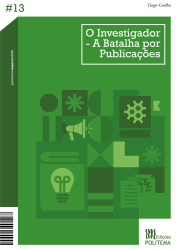
O Investigador - A Batalha por Publicações
Palavras-chave:
Investigação, publicação científica, jogo sérioSinopse
Publicar em revistas científicas com revisão por pares é desafiante. Para além de elaborar um artigo que descreva minuciosamente o processo e os resultados da sua investigação, os autores devem ser capazes de selecionar a revista mais adequada para submissão, tendo em conta fatores como âmbito, indexação, impacto, tempo médio de resposta, política de acesso às publicações, possíveis taxas de processamento e diretrizes editoriais. Além disso, os autores devem estar preparados para analisar as observações dos revisores e ajustar o trabalho conforme necessário, bem como lidar com a possibilidade de rejeição. Isto requer não só proficiência científica, mas também resiliência e capacidade de adaptação ao longo do árduo percurso até publicação.
Com o objetivo primordial de preparar estudantes de ensino superior e investigadores em início de carreira para o processo de publicação de artigos em revistas científicas e desafios frequentemente associados a esta experiência, foi desenvolvido um recurso didático inovador: um jogo sério, de tabuleiro, intitulado “O Investigador - A Batalha por Publicações”. A presente publicação para além de explorar as dificuldades inerentes à publicação científica, também apresenta a descrição detalhada do processo de desenvolvimento do jogo, as suas instruções e material pedagógico complementar.
Com o objetivo principal de preparar estudantes de ensino superior e investigadores em início de carreira para o processo de publicação de artigos em revistas científicas e desafios frequentemente associados a esta experiência, foi desenvolvido, por Tiago Coelho, um recurso didático que se trata de um jogo sério, de tabuleiro, designado como “O Investigador - A Batalha por Publicações”. A presente publicação refere-se às instruções do jogo e material pedagógico complementar.
Referências
Aarssen, L., Tregenza, T., Budden, A., Lortie, C., Koricheva, J., & Leimu-Brown, R. (2008). Bang for Your Buck: Rejection Rates and Impact Factors in Ecological Journals. The Open Ecology Journal, 1. https://doi.org/10.2174/1874213000801010014
Abuhamdeh, S., & Csikszentmihalyi, M. (2012). The importance of challenge for the enjoyment of intrinsically motivated, goal-directed activities. Pers Soc Psychol Bull, 38(3), 317-330. https://doi.org/10.1177/0146167211427147
Al Noman, A., Sarkar, O., Mita, T. M., Siddika, K., & Afrose, F. (2024). Simplifying the concept of level of evidence in lay language for all aspects of learners: In brief review. Intelligent Pharmacy, 2(2), 270-273. https://doi.org/https://doi.org/10.1016/j.ipha.2023.11.002
Ávila-Pesántez, D., Rivera, L. A., & Alban, M. S. (2017). Approaches for serious game design: A systematic literature review. Computers in education journal, 8(3).
Bartolomé, N. A., Zorrilla, A. M., & Zapirain, B. G. (2011, 27-30 July 2011). Can game-based therapies be trusted? Is game-based education effective? A systematic review of the Serious Games for health and education. 2011 16th International Conference on Computer Games (CGAMES),
Beugelsdijk, S., & Bird, A. (2024). How to avoid a desk reject: do’s and don’ts. Journal of International Business Studies. https://doi.org/10.1057/s41267-024-00712-8
Björk, B.-C. (2017). Growth of hybrid open access, 2009–2016. PeerJ, 5, e3878. https://doi.org/10.7717/peerj.3878
Björk, B.-C., Laakso, M., Welling, P., & Paetau, P. (2014). Anatomy of green open access. Journal of the Association for Information Science and Technology, 65(2), 237-250. https://doi.org/https://doi.org/10.1002/asi.22963
Björk, B.-C., & Solomon, D. (2013). The publishing delay in scholarly peer-reviewed journals. Journal of Informetrics, 7(4), 914-923. https://doi.org/https://doi.org/10.1016/j.joi.2013.09.001
Boone, A., Vander Elst, T., Vandenbroeck, S., & Godderis, L. (2022). Burnout Profiles Among Young Researchers: A Latent Profile Analysis [Original Research]. Front Psychol, 13. https://doi.org/10.3389/fpsyg.2022.839728
Bornmann, L., & Marx, W. (2016). The journal Impact Factor and alternative metrics: A variety of bibliometric measures has been developed to supplant the Impact Factor to better assess the impact of individual research papers. EMBO Rep, 17(8), 1094-1097. https://doi.org/10.15252/embr.201642823
Bornmann, L., Marx, W., Gasparyan, A. Y., & Kitas, G. D. (2012). Diversity, value and limitations of the journal impact factor and alternative metrics. Rheumatology International, 32(7), 1861-1867. https://doi.org/10.1007/s00296-011-2276-1
Brembs, B., Button, K., & Munafò, M. (2013). Deep impact: unintended consequences of journal rank [Review]. Front Hum Neurosci, 7. https://doi.org/10.3389/fnhum.2013.00291
Burns, P. B., Rohrich, R. J., & Chung, K. C. (2011). The Levels of Evidence and Their Role in Evidence-Based Medicine. Plastic and Reconstructive Surgery, 128(1), 305-310. https://doi.org/10.1097/PRS.0b013e318219c171
Carpenter, C. R., Cone, D. C., & Sarli, C. C. (2014). Using Publication Metrics to Highlight Academic Productivity and Research Impact. Academic Emergency Medicine, 21(10), 1160-1172. https://doi.org/https://doi.org/10.1111/acem.12482
Chapman, C. A., Bicca-Marques, J. C., Calvignac-Spencer, S., Fan, P., Fashing, P. J., Gogarten, J., Guo, S., Hemingway, C. A., Leendertz, F., Li, B., Matsuda, I., Hou, R., Serio-Silva, J. C., & Chr. Stenseth, N. (2019). Games academics play and their consequences: how authorship, h-index and journal impact factors are shaping the future of academia. Proceedings of the Royal Society B: Biological Sciences, 286(1916), 20192047. https://doi.org/doi:10.1098/rspb.2019.2047
Conn, V. S., Zerwic, J., Jefferson, U., Anderson, C. M., Killion, C. M., Smith, C. E., Cohen, M. Z., Fahrenwald, N. L., Herrick, L., Topp, R., Benefield, L. E., & Loya, J. (2016). Normalizing Rejection. West J Nurs Res, 38(2), 137-154. https://doi.org/10.1177/0193945915589538
Crijns, T. J., Ottenhoff, J. S. E., & Ring, D. (2021). The effect of peer review on the improvement of rejected manuscripts. Accountability in Research, 28(8), 517-527. https://doi.org/10.1080/08989621.2020.1869547
Csikszentmihalyi, M. (1990). Flow: The Psychology of Optimal Experience. Harper & Row.
Dantas-Torres, F. (2022). Top 10 reasons your manuscript may be rejected without review. Parasites & Vectors, 15(1), 418. https://doi.org/10.1186/s13071-022-05543-w
Day, R. A., & Gastel, B. (2012). How to Write and Publish a Scientific Paper (7th ed.). Cambridge University Press.
Deci, E. L., & Ryan, R. M. (1985). Conceptualizations of Intrinsic Motivation and Self-Determination. In Intrinsic Motivation and Self-Determination in Human Behavior (pp. 11-40). Springer US. https://doi.org/10.1007/978-1-4899-2271-7_2
Doran, J. M., Somerville, W., Harlem-Siegel, J., & Steele, H. (2014). The More You Know: The Impact of Publication and Peer-Review Experience on Psychology Graduate Students. Teaching of Psychology, 41(2), 122-129. https://doi.org/10.1177/0098628314530342
Edwards, M. A., & Roy, S. (2017). Academic Research in the 21st Century: Maintaining Scientific Integrity in a Climate of Perverse Incentives and Hypercompetition. Environ Eng Sci, 34(1), 51-61. https://doi.org/10.1089/ees.2016.0223
Eisenhart, M. (2002). The Paradox of Peer Review: Admitting too Much or Allowing too Little? Research in Science Education, 32(2), 241-255. https://doi.org/10.1023/A:1016082229411
Ellinger, A. D., Jonsson, P., Chapman, K., & Ellinger, A. E. (2023). The Ideal Review Process Is a Three-Way Street. Human Resource Development Review, 22(2), 251-274. https://doi.org/10.1177/15344843231170030
Evans, T. M., Bira, L., Gastelum, J. B., Weiss, L. T., & Vanderford, N. L. (2018). Evidence for a mental health crisis in graduate education. Nat Biotechnol, 36(3), 282-284. https://doi.org/10.1038/nbt.4089
Facchino, A. P., Marchetti, D., Colasanti, M., Fontanesi, L., & Verrocchio, M. C. (2025). The use of serious games for psychological education and training: a systematic review [Systematic Review]. Frontiers in Education, Volume 10 - 2025. https://doi.org/10.3389/feduc.2025.1511729
Fernandez-Llimos, F. (2018). Differences and similarities between Journal Impact Factor and CiteScore. Pharm Pract (Granada), 16(2), 1282. https://doi.org/10.18549/PharmPract.2018.02.1282
Frank, J., Foster, R., & Pagliari, C. (2023). Open access publishing – noble intention, flawed reality. Social Science & Medicine, 317, 115592. https://doi.org/https://doi.org/10.1016/j.socscimed.2022.115592
Garfield, E. (2006). The history and meaning of the journal impact factor. JAMA, 295(1), 90-93. https://doi.org/10.1001/jama.295.1.90
Gasparyan, A. Y. (2013). Choosing the target journal: do authors need a comprehensive approach? Journal of Korean Medical Science, 28(8), 1117-1119. https://doi.org/10.3346/jkms.2013.28.8.1117
Gasparyan, A. Y., Nurmashev, B., Yessirkepov, M., Udovik, E. E., Baryshnikov, A. A., & Kitas, G. D. (2017). The Journal Impact Factor: Moving Toward an Alternative and Combined Scientometric Approach. Journal of Korean Medical Science, 32(2), 173-179. https://doi.org/10.3346/jkms.2017.32.2.173
Ghasemi, A., Mirmiran, P., Kashfi, K., & Bahadoran, Z. (2023). Scientific Publishing in Biomedicine: A Brief History of Scientific Journals. Int J Endocrinol Metab, 21(1), e131812. https://doi.org/10.5812/ijem-131812
Hadad, S., & Aharony, N. (2023). Researchers’ perceptions, patterns, motives, and challenges in self-archiving as a function of the discipline. Journal of Librarianship and Information Science, 56(2), 490-500. https://doi.org/10.1177/09610006221146768
Haensly, P. J., Hodges, P. E., & Davenport, S. A. (2008). Acceptance Rates and Journal Quality: An Analysis of Journals in Economics and Finance. Journal of Business & Finance Librarianship, 14(1), 2-31. https://doi.org/10.1080/08963560802176330
Haoran, G., Bazakidi, E., & Zary, N. (2019). Serious Games in Health Professions Education: Review of Trends and Learning Efficacy. Yearb Med Inform, 28(1), 240-248. https://doi.org/10.1055/s-0039-1677904
Hoogenboom, B. J., & Manske, R. C. (2012). How to write a scientific article. Int J Sports Phys Ther, 7(5), 512-517.
Horn, S. A. (2015). The Social and Psychological Costs of Peer Review: Stress and Coping With Manuscript Rejection. Journal of Management Inquiry, 25(1), 11-26. https://doi.org/10.1177/1056492615586597
Huang, C.-K., Neylon, C., Montgomery, L., Hosking, R., Diprose, J. P., Handcock, R. N., & Wilson, K. (2024). Open access research outputs receive more diverse citations. Scientometrics, 129(2), 825-845. https://doi.org/10.1007/s11192-023-04894-0
Hunicke, R., LeBlanc, M., & Zubek, R. (2004). MDA: A formal approach to game design and game research. Proceedings of the AAAI Workshop on Challenges in Game AI,
Ioannidis, J. P. A., Tatsioni, A., & Karassa, F. B. (2010). Who is afraid of reviewers’ comments? Or, why anything can be published and anything can be cited. Eur J Clin Invest, 40(4), 285-287. https://doi.org/https://doi.org/10.1111/j.1365-2362.2010.02272.x
Ioannidis, J. P. A., & Thombs, B. D. (2019). A user's guide to inflated and manipulated impact factors. Eur J Clin Invest, 49(9), e13151. https://doi.org/10.1111/eci.13151
Ismailović, D., Haladjian, J., Köhler, B., Pagano, D., & Brügge, B. (2012, 9-9 June 2012). Adaptive serious game development. 2012 Second International Workshop on Games and Software Engineering: Realizing User Engagement with Game Engineering Techniques (GAS),
Jackson, G. T., Dempsey, K. B., & McNamara, D. S. (2011). Short and Long Term Benefits of Enjoyment and Learning within a Serious Game. In G. Biswas, S. Bull, J. Kay, & A. Mitrovic, Artificial Intelligence in Education Berlin, Heidelberg.
Jahn, N., Matthias, L., & Laakso, M. (2022). Toward transparency of hybrid open access through publisher-provided metadata: An article-level study of Elsevier. Journal of the Association for Information Science and Technology, 73(1), 104-118. https://doi.org/https://doi.org/10.1002/asi.24549
Jaremka, L. M., Ackerman, J. M., Gawronski, B., Rule, N. O., Sweeny, K., Tropp, L. R., Metz, M. A., Molina, L., Ryan, W. S., & Vick, S. B. (2020). Common Academic Experiences No One Talks About: Repeated Rejection, Impostor Syndrome, and Burnout. Perspect Psychol Sci, 15(3), 519-543. https://doi.org/10.1177/1745691619898848
Kaptein, M., & van Kooten, M. (2020). Dilemma Game App [software]. In https://pure.eur.nl/en/publications/dilemma-game-app
Kelly, J., Sadeghieh, T., & Adeli, K. (2014). Peer Review in Scientific Publications: Benefits, Critiques, & A Survival Guide. Ejifcc, 25(3), 227-243.
Khadilkar, S. S. (2018). Rejection Blues: Why Do Research Papers Get Rejected? The Journal of Obstetrics and Gynecology of India, 68(4), 239-241. https://doi.org/10.1007/s13224-018-1153-1
King, E. B., Avery, D. R., Hebl, M. R., & Cortina, J. M. (2017). Systematic Subjectivity: How Subtle Biases Infect the Scholarship Review Process. Journal of Management, 44(3), 843-853. https://doi.org/10.1177/0149206317743553
King, M. M., Bergstrom, C. T., Correll, S. J., Jacquet, J., & West, J. D. (2017). Men Set Their Own Cites High: Gender and Self-citation across Fields and over Time. Socius, 3, 2378023117738903. https://doi.org/10.1177/2378023117738903
Krath, J., Schürmann, L., & von Korflesch, H. F. O. (2021). Revealing the theoretical basis of gamification: A systematic review and analysis of theory in research on gamification, serious games and game-based learning. Computers in Human Behavior, 125, 106963. https://doi.org/https://doi.org/10.1016/j.chb.2021.106963
Kubátová, J. (2019). Does Academic Publishing Lead to Work-Related Stress or Happiness? Publications, 7(4), 66. https://www.mdpi.com/2304-6775/7/4/66
Kwok, L. S. (2005). The White Bull effect: abusive coauthorship and publication parasitism. Journal of Medical Ethics, 31(9), 554-556. https://doi.org/10.1136/jme.2004.010553
Laamarti, F., Eid, M., & El Saddik, A. (2014). An Overview of Serious Games. International Journal of Computer Games Technology, 2014(1), 358152. https://doi.org/https://doi.org/10.1155/2014/358152
Larivière, V., & Sugimoto, C. R. (2019). The Journal Impact Factor: A Brief History, Critique, and Discussion of Adverse Effects. In W. Glänzel, H. F. Moed, U. Schmoch, & M. Thelwall (Eds.), Springer Handbook of Science and Technology Indicators (pp. 3-24). Springer International Publishing. https://doi.org/10.1007/978-3-030-02511-3_1
Lee, C. J., Sugimoto, C. R., Zhang, G., & Cronin, B. (2013). Bias in peer review. Journal of the American Society for Information Science and Technology, 64(1), 2-17. https://doi.org/https://doi.org/10.1002/asi.22784
Levecque, K., Anseel, F., De Beuckelaer, A., Van der Heyden, J., & Gisle, L. (2017). Work organization and mental health problems in PhD students. Research Policy, 46(4), 868-879. https://doi.org/https://doi.org/10.1016/j.respol.2017.02.008
Lewis, R. G., Florio, E., Punzo, D., & Borrelli, E. (2021). The Brain's Reward System in Health and Disease. Adv Exp Med Biol, 1344, 57-69. https://doi.org/10.1007/978-3-030-81147-1_4
Lobão, R. (2023). Jogo sério sobre o processo de publicação científica: avaliação das características do jogo e impacto nos conhecimentos e perceção de competências em estudantes do ensino superior [Licenciatura em Terapia Ocupacional, Escola Superior de Saúde do Politécnico do Porto]. Porto.
McKiernan, E. C., Schimanski, L. A., Muñoz Nieves, C., Matthias, L., Niles, M. T., & Alperin, J. P. (2019). Use of the Journal Impact Factor in academic review, promotion, and tenure evaluations. eLife, 8. https://doi.org/10.7554/eLife.47338
Melnyk, B. M., & Fineout-Overholt, E. (2023). Evidence-based practice in nursing & healthcare : a guide to best practice (Fifth edition. ed.). Wolters Kluwer.
Melnyk, B. M., Gallagher-Ford, L., & Fineout-Overholt, E. (2016). Implementing the Evidence-Based Practice (EBP) Competencies in Healthcare: A Practical Guide for Improving Quality, Safety, and Outcomes. Sigma Theta Tau International.
Michalska-Smith, M. J., & Allesina, S. (2017). And, not or: Quality, quantity in scientific publishing. PLoS One, 12(6), e0178074. https://doi.org/10.1371/journal.pone.0178074
Murad, M. H., Asi, N., Alsawas, M., & Alahdab, F. (2016). New evidence pyramid. Evidence Based Medicine, 21(4), 125. https://doi.org/10.1136/ebmed-2016-110401
Nagy, G. A., Fang, C. M., Hish, A. J., Kelly, L., Nicchitta, C. V., Dzirasa, K., & Rosenthal, M. Z. (2019). Burnout and Mental Health Problems in Biomedical Doctoral Students. CBE Life Sci Educ, 18(2), ar27. https://doi.org/10.1187/cbe.18-09-0198
Paltridge, B. (2015). Referees' comments on submissions to peer-reviewed journals: when is a suggestion not a suggestion? Studies in Higher Education, 40(1), 106-122. https://doi.org/10.1080/03075079.2013.818641
Paulus, F. M., Cruz, N., & Krach, S. (2018). The Impact Factor Fallacy. Front Psychol, 9, 1487. https://doi.org/10.3389/fpsyg.2018.01487
Paulus, F. M., Rademacher, L., Schäfer, T. A., Müller-Pinzler, L., & Krach, S. (2015). Journal Impact Factor Shapes Scientists' Reward Signal in the Prospect of Publication. PLoS One, 10(11), e0142537. https://doi.org/10.1371/journal.pone.0142537
Perttula, A., Kiili, K., Lindstedt, A., & Tuomi, P. (2017). Flow experience in game based learning – a systematic literature review. International Journal of Serious Games, 4(1). https://doi.org/10.17083/ijsg.v4i1.151
Powell, K. (2016). Does it take too long to publish research? Nature, 530(7589), 148-151. https://doi.org/10.1038/530148a
Ravyse, W. S., Seugnet Blignaut, A., Leendertz, V., & Woolner, A. (2017). Success factors for serious games to enhance learning: a systematic review. Virtual Reality, 21(1), 31-58. https://doi.org/10.1007/s10055-016-0298-4
Runde, B. J. (2021). Time to publish? Turnaround times, acceptance rates, and impact factors of journals in fisheries science. PLoS One, 16(9), e0257841. https://doi.org/10.1371/journal.pone.0257841
Ryan, R. M., & Deci, E. L. (2020). Intrinsic and extrinsic motivation from a self-determination theory perspective: Definitions, theory, practices, and future directions. Contemporary Educational Psychology, 61, 101860. https://doi.org/https://doi.org/10.1016/j.cedpsych.2020.101860
Scholz, F. (2022). Writing and publishing a scientific paper. ChemTexts, 8(1), 8. https://doi.org/10.1007/s40828-022-00160-7
Schrader, C. (2022). Serious Games and Game-Based Learning. In Handbook of Open, Distance and Digital Education (pp. 1-14). Springer Singapore. https://doi.org/10.1007/978-981-19-0351-9_74-1
Simons, K. (2008). The Misused Impact Factor. Science, 322(5899), 165-165. https://doi.org/doi:10.1126/science.1165316
Sousa, C., Rye, S., Sousa, M., Torres, P. J., Perim, C., Mansuklal, S. A., & Ennami, F. (2023). Playing at the school table: Systematic literature review of board, tabletop, and other analog game-based learning approaches [Review]. Front Psychol, Volume 14 - 2023. https://doi.org/10.3389/fpsyg.2023.1160591
Speelman, E. N., Escano, E., Marcos, D., & Becu, N. (2023). Serious games and citizen science; from parallel pathways to greater synergies. Current Opinion in Environmental Sustainability, 64, 101320. https://doi.org/https://doi.org/10.1016/j.cosust.2023.101320
Sugimoto, C. R., Larivière, V., Ni, C., & Cronin, B. (2013). Journal acceptance rates: A cross-disciplinary analysis of variability and relationships with journal measures. Journal of Informetrics, 7(4), 897-906. https://doi.org/https://doi.org/10.1016/j.joi.2013.08.007
Teixeira da Silva, J. A., Al-Khatib, A., Katavić, V., & Bornemann-Cimenti, H. (2018). Establishing Sensible and Practical Guidelines for Desk Rejections. Science and Engineering Ethics, 24(4), 1347-1365. https://doi.org/10.1007/s11948-017-9921-3
Tennant, J. P., Waldner, F., Jacques, D. C., Masuzzo, P., Collister, L. B., & Hartgerink, C. H. (2016). The academic, economic and societal impacts of Open Access: an evidence-based review. F1000Res, 5, 632. https://doi.org/10.12688/f1000research.8460.3
Tori, A. A., Tori, R., & Nunes, F. d. L. d. S. (2022). Serious Game Design in Health Education: A Systematic Review. IEEE Transactions on Learning Technologies, 15(6), 827-846. https://doi.org/10.1109/TLT.2022.3200583
Tregoning, J. (2018). How will you judge me if not by impact factor? Nature, 558(7710), 345. https://doi.org/10.1038/d41586-018-05467-5
Turbek, S. P., Chock, T. M., Donahue, K., Havrilla, C. A., Oliverio, A. M., Polutchko, S. K., Shoemaker, L. G., & Vimercati, L. (2016). Scientific Writing Made Easy: A Step-by-Step Guide to Undergraduate Writing in the Biological Sciences. The Bulletin of the Ecological Society of America, 97(4), 417-426. https://doi.org/https://doi.org/10.1002/bes2.1258
Vygotsky, L. S. (1978). Mind in society: The development of higher psychological processes (Vol. 86). Harvard university press.
Wallace, S. S., Barak, G., Truong, G., & Parker, M. W. (2022). Hierarchy of Evidence Within the Medical Literature. Hospital Pediatrics, 12(8), 745-750. https://doi.org/10.1542/hpeds.2022-006690
Willmott, H. (2021). Critical essay: Blinding faith – Paradoxes and pathologies of opacity in peer review. Human Relations, 75(9), 1741-1769. https://doi.org/10.1177/00187267211016752
Woolston, C. (2015). Long wait for publication plagues many journals. Nature, 523(7559), 131-131. https://doi.org/10.1038/523131f
Wouters, P., Nimwegen, C., Oostendorp, H., & Spek, E. (2013). A Meta-Analysis of the Cognitive and Motivational Effects of Serious Games. Journal of Educational Psychology, 105, 249. https://doi.org/10.1037/a0031311
Xu, Y., Lin, Y., Yu, M., & Zhou, K. (2024). The nucleus accumbens in reward and aversion processing: insights and implications. Front Behav Neurosci, 18, 1420028. https://doi.org/10.3389/fnbeh.2024.1420028
Young, J. S., & Brandes, P. M. (2020). Green and gold open access citation and interdisciplinary advantage: A bibliometric study of two science journals. The Journal of Academic Librarianship, 46(2), 102105. https://doi.org/https://doi.org/10.1016/j.acalib.2019.102105
Zhonggen, Y. (2019). A Meta-Analysis of Use of Serious Games in Education over a Decade. International Journal of Computer Games Technology, 2019(1), 4797032. https://doi.org/https://doi.org/10.1155/2019/4797032
Downloads
Publicado
2026
Séries
Categorias
Direitos de Autor (c) 2026 Tiago Coelho

Detalhes sobre esta monografia
ISBN-13 (15)
978-989-9226-27-2